
Zeolite, bentonite or medicinal clay: What is the difference?
Three natural minerals, three completely different ways of binding. What sets them apart, what each is suitable for – and why a mixture rarely makes sense.
 AI-generated
Zeolite, bentonite and medicinal clay at a glance
| Feature | Zeolite Clinoptilolite | Bentonite Montmorillonite | Medicinal clay Loess or clay |
|---|---|---|---|
| What it is | Volcanic mineral, clinoptilolite | Rock, predominantly montmorillonite | Collective term, mostly loess or clay |
| Crystal structure | Tectosilicate, rigid 3D lattice | Phyllosilicate, layers stacked on top of each other | varies depending on the product |
| Behaviour in water | does not swell | swells strongly, forms a gel | swells only slightly |
| Binding principle | Ion exchange in rigid pores | Surface and intercalation between the layers | Acid binding in the stomach |
| Selective binding | yes, about the pore size | area-wide, non-selective | not applicable |
| Evidence for harmful substance binding in humans | clinical studies, verifiable via DOI | no reliable human data | no reliable human data |
| Remains in the digestive tract | yes | yes | yes |
| Typical application | Intestinal barrier, heavy metal binding | acute diarrhoea, animal nutrition | acid-related stomach complaints, externally |
| Product status | Medical device (PMA-Zeolith®: CE); not authorised as a food supplement | varies by product – check the packaging | partly a traditional medicinal product for acid-related stomach complaints, partly a cosmetic |
| Evidence in humans | clinical studies on the bowel with PMA-Zeolith® | no controlled human studies; authorisation as a feed additive | no controlled human studies; traditional use |
| Interval from medicines | at least 2 hours | at least 2 hours | at least 2 hours |
What is zeolite?
A volcanic mineral. For use in the gut, essentially only one variety is relevant: clinoptilolite. Chemically, a framework silicate – silicon and aluminium units form a rigid three-dimensional lattice with fine, uniformly sized channels. Exchangeable ions sit in these channels. The structure does not swell and does not change in the gastrointestinal tract.
What is bentonite?
Not an individual mineral but a rock. Its main constituent is montmorillonite, a phyllosilicate: the structural units are arranged in layers stacked one above another, like pages in a book. Water intercalates between these layers – therefore bentonite swells considerably and forms a gel. Its application is based precisely on this.
What is medicinal clay?
An umbrella term for finely ground natural earths, not a defined mineral. What it contains depends on the manufacturer: mostly loess, sometimes clay mineral mixtures, occasionally bentonite. The authorised use is the binding of stomach acid; for targeted binding of harmful substances in the intestine, there are no robust data in humans.
The crucial difference: how the three bind
All three bind substances in the gut. But they do so in three different ways, and everything else follows from that.
Zeolite – ion exchange in fixed-size pores
In the channels of the crystal lattice sit ions that can be exchanged for others. Zeolite, for example, releases calcium and takes up heavy metal ions in return. Because the pores are always the same size, the structure acts like a sieve: what does not fit in is not bound. That makes the binding selective.
Bentonite – swelling and surface area
Bentonite binds by substances adsorbing onto the vast surface area of its layers and migrating between the layers. In the process, the material swells. As a result it binds a great deal – but less selectively, because there is no fixed pore size to sort things out.
Medicinal clay – acid binding in the stomach
Medicinal clay acts mainly in the stomach, not in the gut: it buffers acid; this underpins the registration of certain products as traditional medicinal products. Targeted binding of harmful substances has not been demonstrated. Because the composition varies from product to product, little more can be generalised.
AI-generated
Which mineral is suitable for what?
Zeolite
Investigated and approved as a medical device for the intestinal barrier: PMA-Zeolith® has been evaluated in clinical studies for irritable bowel syndrome and for binding heavy metals in the gastrointestinal tract. Of the three materials, it is the only one for which controlled studies in humans are available.
Bentonite
Traditionally used for acute diarrhoea because its swelling binds water in the intestine. Authorised in animal feed as an additive against mycotoxins. There are no controlled human studies on contaminant binding.
Medicinal clay
Established for acid-related stomach complaints; certain products are registered for this purpose as traditional medicinal products. For external use in masks and compresses. No human data are available for the binding of harmful substances in the intestine.
Can you take zeolite and bentonite together?
Such mixtures are frequently sold. Based on current evidence, there is no proven additional benefit of the combination – studies comparing a mixture with the individual substances are lacking.
What can be said, however, is that there are no studies on the simultaneous use of both substances. Bentonite swells markedly in the intestine and thereby changes stool consistency – combined with a second binding agent, the risk of constipation increases. In addition, a time gap from medicines must be observed with both substances.
Why there is no zeolite-bentonite mixture at PANACEO
Three reasons – and none of them is "because bentonite is bad".
The studies apply to the single substance.
PMA-Zeolith® was investigated – on its own, in a defined quantity. A mixture is a different product, and the results cannot simply be transferred.
A medical device requires a defined composition
What is present, and in what quantities, must be clearly established and remain controllable. In the case of a mixture of two natural substances with variable composition, this becomes significantly more difficult.
Otherwise you won't know how much of each to take
With „50 : 50“, it is unclear whether the amount of zeolite still corresponds to the tested daily dose. Anyone wanting to use it in a targeted way needs a clear figure.
Frequently asked questions about zeolite, bentonite and medicinal clay
Sources and expert review
This page is based on the manufacturer's package leaflet and on published studies.
Information provided by the manufacturer
Information on administration, contraindications and the timing relative to other medicines is taken from the patient information leaflet for PANACEO MED DARM REPAIR.
Safety of zeolite clinoptilolite
Review of the evidence base on tolerability, purity requirements, and the distinction between tested medical devices and untested products.
Blood values on PMA-Zeolith®
No increase in aluminium or lead after administration; after four years, lower aluminium and nickel levels.
Irritable bowel syndrome: inflammatory markers with PMA-Zeolith®
Double-blind, controlled pilot study with 41 patients with irritable bowel syndrome over 3 months.


Last checked on
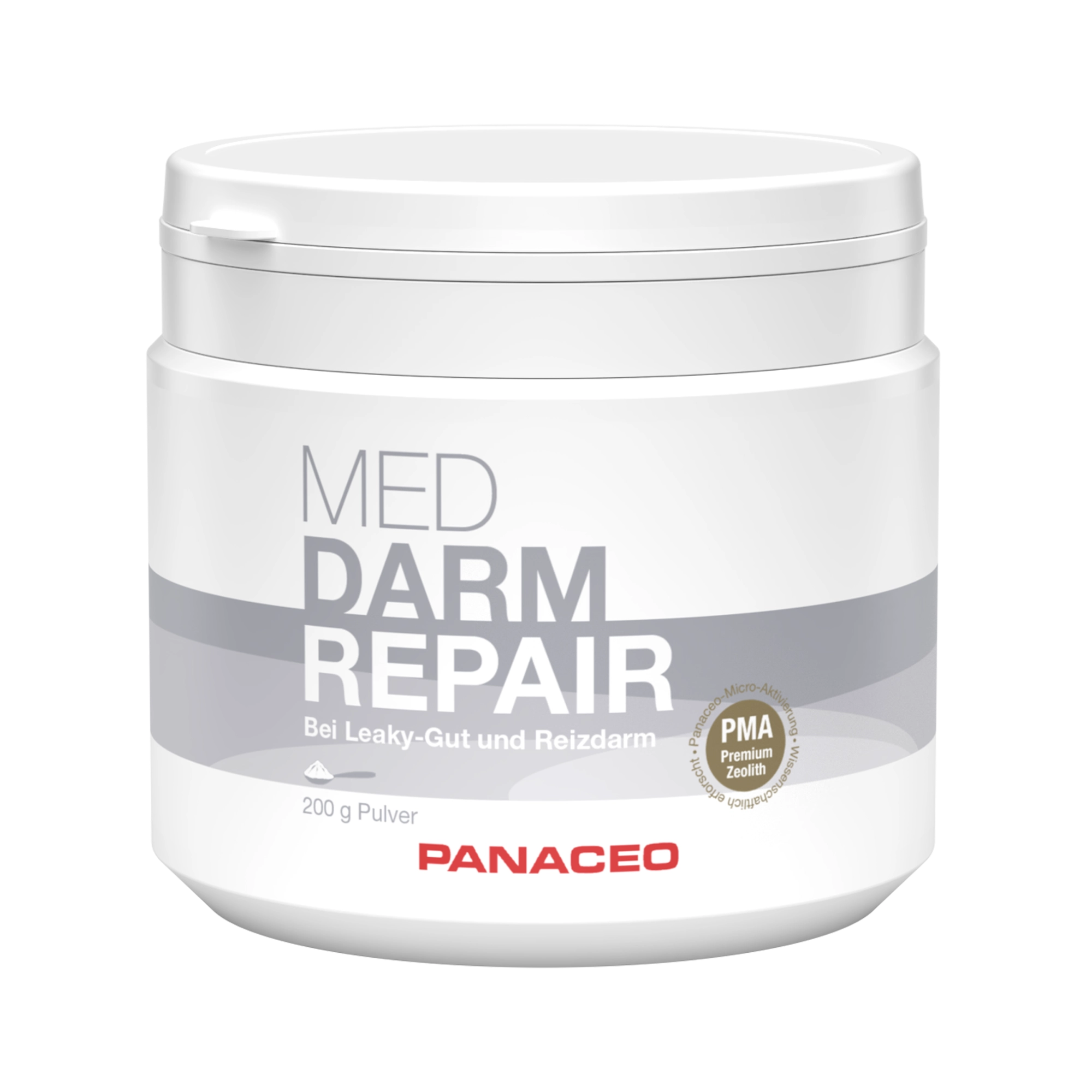
PANACEO MED DARM REPAIR is a CE-certified medical device with 100% PMA-Zeolith®, available as a powder and as capsules.
 Available as a medical device
PANACEO MED DARM REPAIR Powder 200 g
Powder: 200 g
from
€24.90
Available as a medical device
PANACEO MED DARM REPAIR Powder 200 g
Powder: 200 g
from
€24.90
Find out more about zeolite
What is zeolite?
Origin, structure and mode of action of the volcanic mineral
Which zeolite is the best?
How to recognise inspected items
Zeolite side effects
What is known and what to look out for