
Which zeolite is the best? How to recognise quality
Five criteria that can be assessed for any product – and what 'test winner' really means.
 AI-generated
Is there a zeolite test winner?
In short: No, at any rate not from an independent testing institute. We are not aware of any test of zeolite by Stiftung Warentest or Ökotest (as of October 2026).
What appears under "zeolite test winner" in the search results are comparison websites. They do not test in a laboratory; instead, they compare product data and earn commissions from the linked shops. On marketplaces, the same shows up as a private label: "comparison winner" appears there in the product title, awarded by the seller themselves.
That does not make these sites worthless – but a seal without a testing institute and without testing criteria is no proof of quality. It is more reliable to go through the features yourself.
Five characteristics by which you recognise quality
All five can be checked on any product – including ours.
What product status does the product have?
Is there a CE marking on the packaging, and are instructions for use enclosed? Then it is a medical device, and the manufacturer had to demonstrate the intended purpose, clinical evaluation and risk analysis. If zeolite is offered as a food supplement, there is no authorisation for it.
What is the clinoptilolite content?
Zeolite is an umbrella term for over 40 minerals. For use in the gut, clinoptilolite is what matters. Reputable suppliers specify the proportion and can substantiate it. If this information is missing, it is unclear what is actually in the product.
Are there tests for heavy metals?
Natural minerals from a deposit always contain accompanying substances. What matters is not whether testing has been carried out, but whether the results are available on request – and whether testing is ongoing rather than a one-off.
Are the origin and the method stated?
From which deposit is the raw material sourced, and what happens to it? Grind size and processing alter its properties. Anyone who does not specify both either does not have them under control or does not wish to disclose them.
Are there any studies on this specific raw material?
The most commonly overlooked criterion. Studies on 'zeolite' in general say nothing about a specific product. What is tested is always a defined raw material in a defined quantity – and the result applies only to that.
Which product status is zeolite actually allowed to have?
This is where the biggest difference between two zeolite products lies — and it is rarely explained.
Zeolite may not be sold as a food supplement
Clinoptilolite has no authorisation as a novel food in the EU. Under the Novel Food Regulation, there is therefore no basis for placing it on the market as a food supplement. Products that are nevertheless offered as such cannot be lawfully placed on the market — regardless of how good the raw material in them may be.
As a medical device
That is the intended route, and it requires evidence: a defined intended purpose, a clinical evaluation, a risk analysis, instructions for use, and a monitored quality management system. The CE marking on the packaging indicates this. The mode of action must be physical — a medical device must not act pharmacologically. Within medical devices there are classes: the higher the class, the more thorough the assessment. Products for prolonged use in the gastrointestinal tract fall into Class IIb.
What this means for your purchasing decision
First, check what it says on the packaging. If you find no CE marking and no instructions for use, but instead the designation “food supplement”, then this product already lacks the proper legal basis. This is not a detail only for lawyers: where the authorisation is missing, the documents buyers would like to have are usually missing as well — intended purpose, test reports, batch control.

Zeolite as a powder or as capsules?
The same raw material, two dosage forms. The choice depends less on its effect than on your daily routine.
Powder can be dosed freely, contains no additives whatsoever and is cheaper per gram. However, you need a glass, water and a moment of time – and the mineral taste is noticeable.
Capsules are pre-dosed, flavourless and work on the go. The shell is made of cellulose, with no additional excipients. However, the amount per capsule is fixed.
If you’re using it at home and want to adjust the amount, you’ll be better off with the powder. If you need a fixed routine and are often on the go, go for the capsules.
Powder and capsules compared
| Feature | Powder MED GUT REPAIR | Capsules MED GUT REPAIR |
|---|---|---|
| Raw material | PMA-zeolite (clinoptilolite) | the same PMA zeolite |
| Dosage | freely adjustable with the measuring spoon | fixed per capsule |
| PMA-Zeolith® per unit | 3 g per portion | 410 mg per capsule |
| Income | stir into water | swallow with water |
| Flavour | mineral, noticeable | neutral |
| Additives | none | vegan cellulose casing |
| Practical on the go | restricted | yes |
| Suitable for | Home use, adjusted quantity | fixed routine, travel, office |
Frequently asked questions about zeolite quality
Sources and expert review
This page is based on the manufacturer's package leaflet and on published studies.
Information provided by the manufacturer
Information on quantities, composition and directions for use is taken from the package leaflet for PANACEO MED DARM REPAIR.
Safety of zeolite clinoptilolite
Review of the evidence base on tolerability, purity requirements, and the distinction between tested medical devices and untested products.
Blood values on PMA-Zeolith®
Three studies with PMA-Zeolite® over 28 days, 12 weeks and 4 years; no increase in aluminium or lead after intake.
Irritable bowel syndrome: inflammatory markers with PMA-Zeolith®
Double-blind, controlled pilot study with 41 patients with irritable bowel syndrome over 3 months.


Last checked on
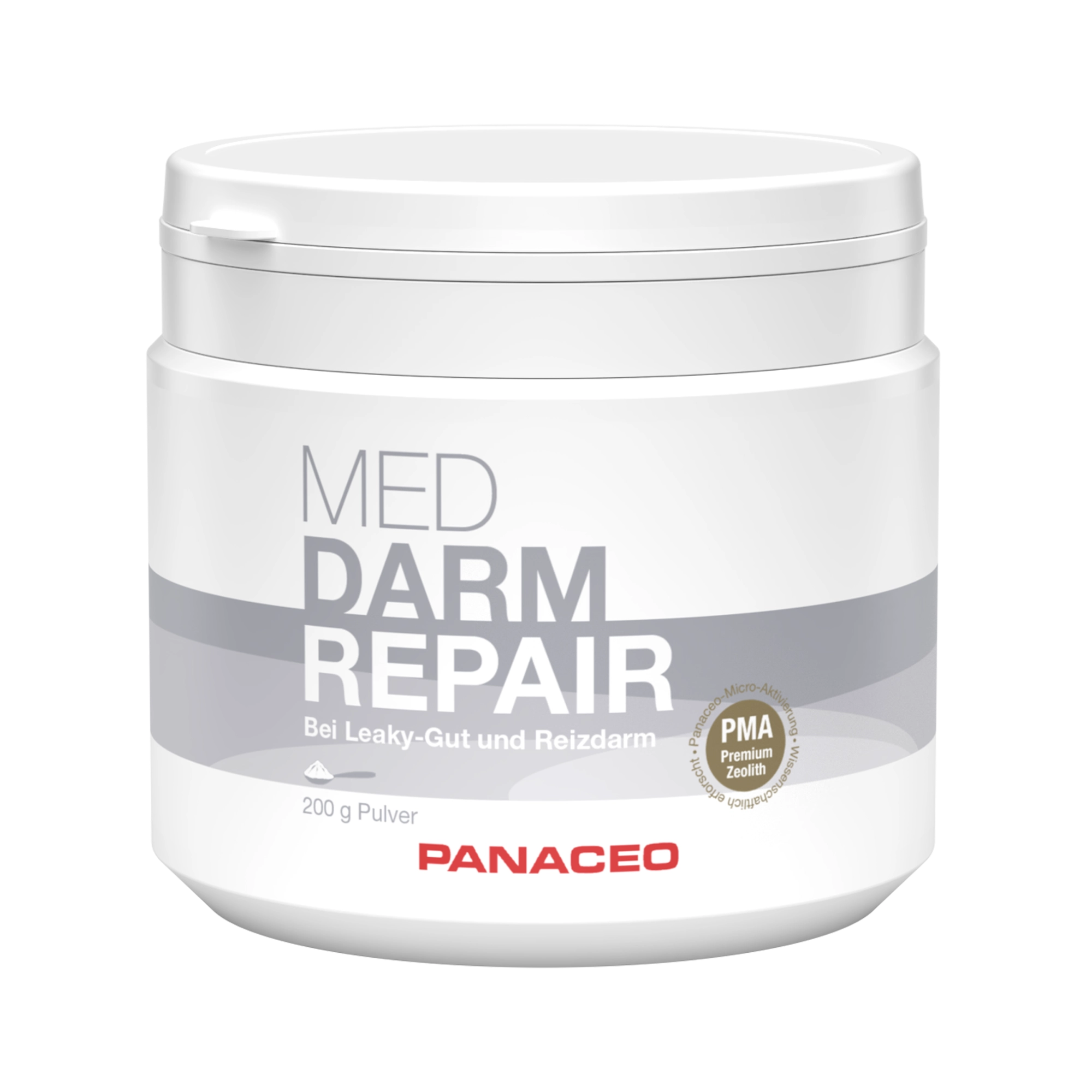
PANACEO MED DARM REPAIR is a CE-certified medical device with 100% PMA-Zeolith®, available as a powder and as capsules.
 Available as a medical device
PANACEO MED DARM REPAIR Powder 200 g
Powder: 200 g
from
€24.90
Available as a medical device
PANACEO MED DARM REPAIR Powder 200 g
Powder: 200 g
from
€24.90
Find out more about zeolite
What is zeolite?
Origin, structure and mode of action of the volcanic mineral
Zeolite, bentonite or medicinal clay?
What distinguishes the three minerals
\nZeolite side effects
What is known and what to look out for